
Wood County Release Date Meanings
A scheduled date belongs to a sentence calculation. WVDCR calls its verified internal milestone the Minimum Discharge Date, or MDD, also described as the final release date. Policy Directive 454.10 defines it as the scheduled sentence-release date if the person remains continuously incarcerated and does not lose good time. Policy Directive 151.07 says the time sheet records the overall MDD or final release date, combines applicable sentences, is given to the inmate, and is entered in the Offender Information System.
Actual release is the later, physical custody event. It needs a release date and time, release method, movement or destination record, VINE status change, or facility confirmation. A projected date can move before then. A court can change the sentence. Credits can be forfeited or restored. A detainer can send the person to another custodian. Parole may allow an earlier supervised release, while mandatory supervision may put the person in the community before all supervision ends.
Scheduled versus actual: Wood County release planning should treat MDD as conditional and confirm the physical exit through WVDCR, VINE, the facility, or the court.
Pretrial custody is different. An unsentenced person at North Central Regional Jail may leave on bond, after dismissal, or under another court order. There is no sentence-based date to calculate. The magistrate or circuit case and the WVDCR custody record are the right sources.
Find Wood County Projected Dates
The public WVDCR search does not have a verified, stable field labeled “Projected Release Date” for Wood County. The applications were access-blocked during research, and no qualifying public person result could confirm the present labels or whether discharged records remain visible. Do not rely on a claim that the public prison page will always display MDD. Use the public search to identify the correct custody stream, then ask for the operative time sheet or public release fields if the date is absent.
WVDCR's public information policy identifies several fields that make a date request more exact: projected minimum discharge date, full-term expiration date, good-time allowance and rate, incarceration or jail-credit time, sentence date and term, mandatory-release date when applicable, parole eligibility date, and actual date and time of release. These are not interchangeable. Request the fields needed for the question and ask the agency to preserve its own labels. The OID and court docket number help connect the calculation to the right person and judgment.
- Decide whether the person is pretrial, serving a regional-jail sentence, or serving a state-prison sentence. The judgment and current location help make that distinction.
- Open the WVDCR offender-search hub. Use Offender Search (Jails) for regional-jail custody and Offender Search (Prisons) for a state-prison sentence.
- Compare the full name, OID, date of birth, facility, court docket, and offense details when the live result supplies them. Never choose a record by name alone.
- Read the judgment for the sentence effective date, jail credit, and concurrent or consecutive terms. A public index may require a clerk request for the actual order.
- Ask WVDCR for the existing time sheet and the minimum discharge or final release date when the public result does not show the operative calculation.
- Confirm release separately after the expected date passes. The Wood County release record path identifies the fields that document an actual departure or transfer.
Record exactly what the live source says and the date checked. If the result supplies only a current location, do not turn that into a release estimate. A missing regional-jail entry can reflect transfer to the prison system, another facility, or a database update. Search both WVDCR custody indexes before calling the change a release.
If a written request is needed, identify the facility, approximate custody period, sentencing court, docket number, and OID when known. Ask for the current time sheet rather than a new calculation. West Virginia public-records law reaches existing records; it does not require WVDCR staff to answer a hypothetical sentence question or create a custom projection. Protected material may be redacted while public sentence and release fields are produced.
Note: WVDCR's public person page has no research-verified projected-date label, so request the time sheet instead of promising an online field.
Wood County Jail Date Sources
Wood County does not operate a conventional long-term county jail roster. The Sheriff runs a short-term Holding Center, while WVDCR operates North Central Regional Jail and Correctional Facility for Wood and seven other counties. This split matters for release-date questions. Someone leaving the Holding Center may be transported to NCRJCF, not released to the community. A movement record and court order resolve that event better than a visual assumption.
For a pretrial case, search the statewide magistrate and circuit-court channels. A magistrate bond order, dismissal, or preliminary felony action may control the next event. A felony sentencing or later order may appear at circuit court. The order explains legal authority, yet it may not give the exact gate-out time. Ask WVDCR or the Sheriff for a dated custody movement or discharge entry when timing matters.
| Wood County situation | Date source | What it can establish |
|---|---|---|
| Pretrial at NCRJCF | Magistrate or circuit order plus WVDCR status | Bond or disposition and whether custody changed |
| Short-term Holding Center stay | Sheriff holding or movement record | Local release versus transport to NCRJCF |
| Sentenced regional-jail term | Judgment, jail credit, and WVDCR calculation | Sentence basis and conditional discharge date |
| State-prison sentence | WVDCR time sheet and prison offender record | MDD or final release calculation and later actual status |
The Daily Incarcerations report is not a release-date ledger. WVDCR warns that fast-changing data may not show the true current location, release date, or status. It is a lead, not the last word.
Wood County Good-Time Calculation
West Virginia Code §15A-4-17 supplies the main good-time rule for eligible adults committed to WVDCR. It generally awards one day of good time for each day physically incarcerated. Presentence jail days count when the sentencing court credits them under the governing rule. Time on parole, bond, or another status outside physical incarceration does not earn this credit. Life-sentenced inmates are not eligible, and the statute contains other exclusions.
West Virginia does not have a verified general rule that every state prisoner must serve about 85 percent of a sentence. That federal shorthand should not be imported into a Wood County state case. Specific offenses can have minimums, limits, or delayed parole eligibility. The judgment and the statute tied to that offense control. WVDCR's time sheet then applies the sentence structure and credits to the individual record.
The official good-time statute source is shown in the capture below.
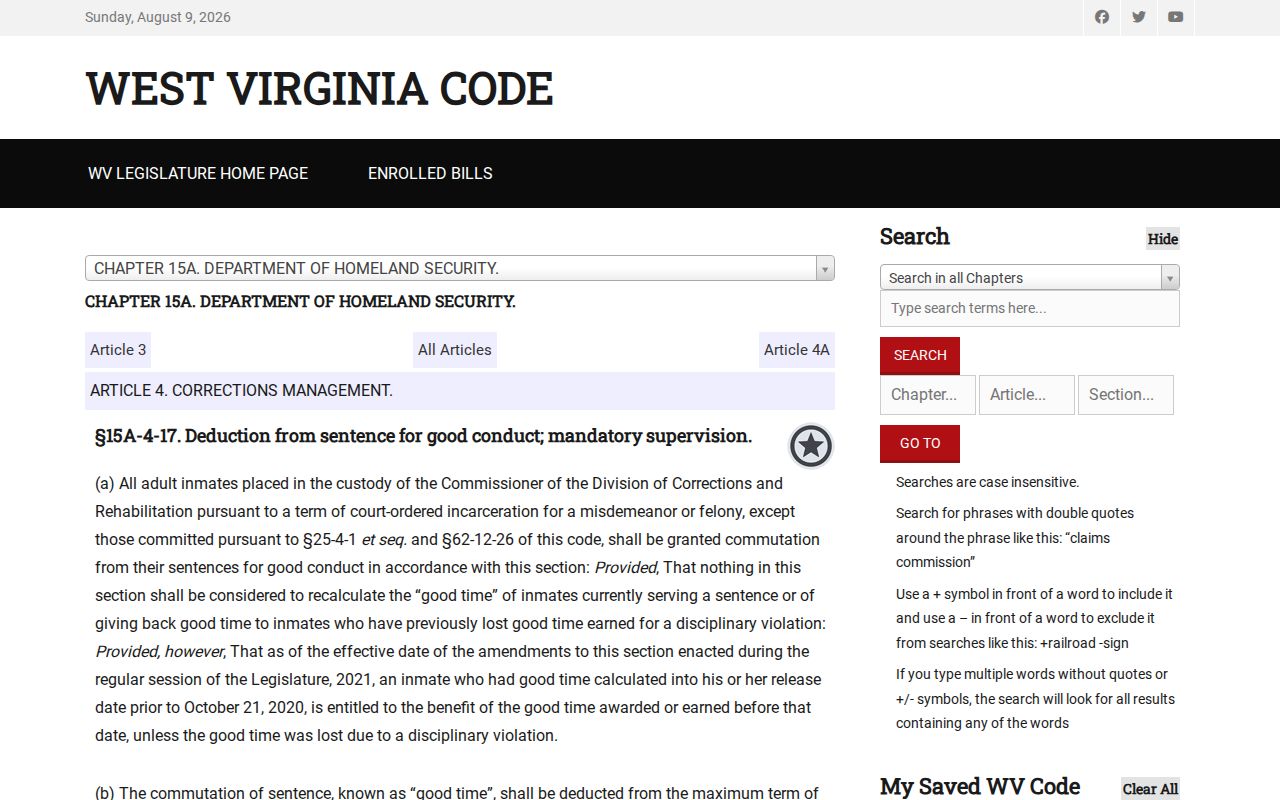
The captured law supports the one-day-per-day framework, its exclusions, and the rules for changing earned credit.
Consecutive sentences are combined for this calculation. WVDCR must issue a revised statement when forfeiture, restoration, or extra credit changes the earliest discharge date. Presentence credit, sentence effective dates, and whether terms run together or back-to-back can make rough arithmetic wrong.
Wood County Mandatory Supervision Dates
A person can leave the institution before every part of the sentence relationship ends. Section 15A-4-17 creates a year of mandatory post-release supervision for specified covered felonies by deducting that year from accumulated good time. Other felony cases may receive a shorter court-ordered period under the statute. Section 15A-4-17a and WVDCR conditional-release policy also address a supervised-release route for certain eligible people near minimum expiration.
This means a first calculated discharge date can mark movement from a WVDCR facility into monitored community supervision, not final discharge from all supervision. The release document should name the legal route and the later supervision date. A detainer can also prevent community release under conditional-release rules. If another county, state, federal, or out-of-state agency takes custody, the person has left one institution but has not become free of custody.
- PED
- The first date for parole consideration, not a promised exit date.
- MDD or final release date
- WVDCR's conditional sentence calculation if continuous custody and earned credit remain as assumed.
- Mandatory supervision
- A community supervision phase required by statute or order before full discharge.
- Actual release
- The dated event in which WVDCR records a physical release or transfer.
Note: Community placement under mandatory supervision is a release from the institution, but it is not the same as final discharge.
Changes to Wood County Release Dates
A projected date is revised when a lawful input changes. Some changes move it later; others can move it earlier. The person-specific WVDCR time sheet is the best way to see how those inputs combine. Court orders and custody records should be read alongside it when the sentence or detainer picture has changed.
| Factor | Possible effect | Record to check |
|---|---|---|
| Good-time forfeiture | Can move earliest discharge later after discipline | Revised WVDCR time sheet and disciplinary credit entry |
| Credit restoration or extra good time | Can move the calculation earlier when law and approval allow | Revised time sheet |
| Presentence jail credit | Changes credited time when ordered by the court | Judgment and WVDCR calculation |
| Concurrent or consecutive sentences | Changes whether terms overlap or aggregate | Sentencing orders and time sheet |
| Detainer or hold | May route the person to another custodian rather than the community | Hold, movement, and release-destination records |
| Parole action | May permit supervised release before MDD, but a hearing or grant is not physical release | Board action plus WVDCR actual-release confirmation |
Parole eligibility must remain separate from sentence discharge. The official West Virginia parole eligibility statute is captured below.
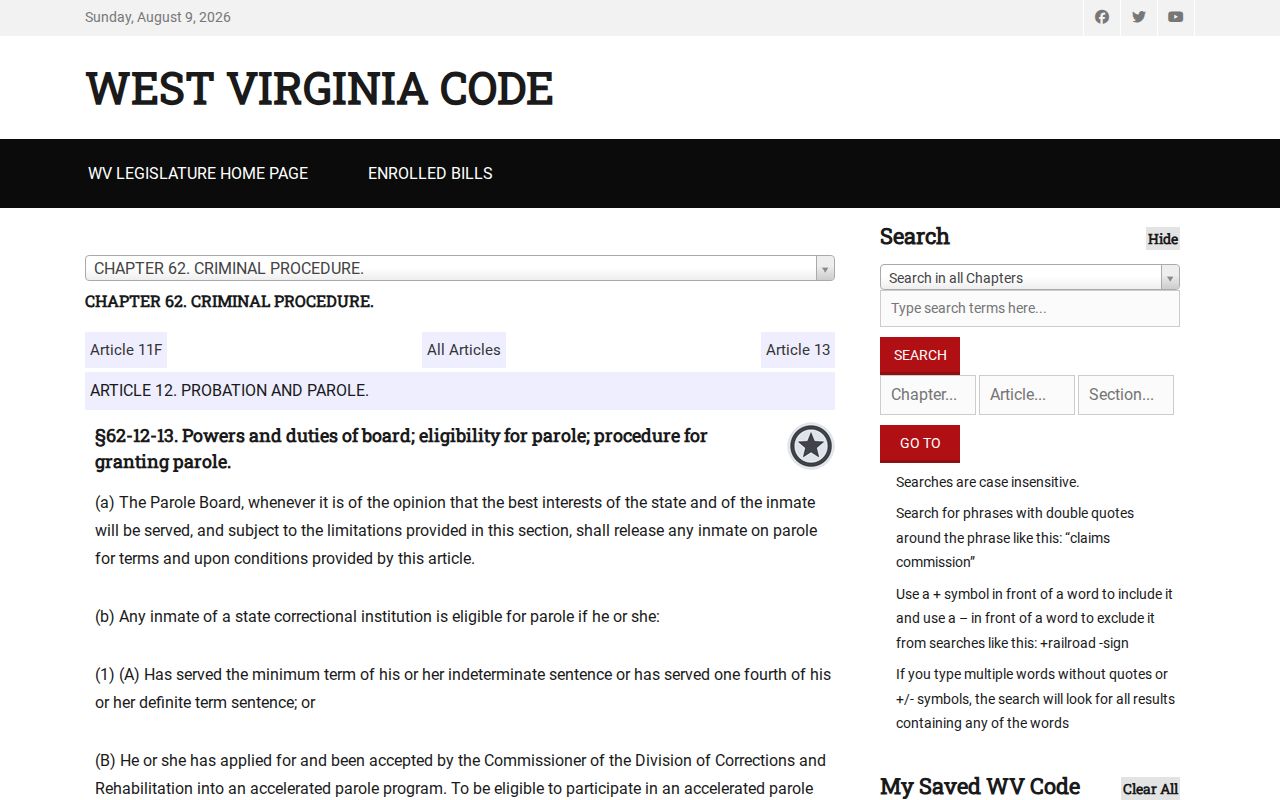
The source shows why a PED is a consideration point governed by the sentence, not an actual Wood County release record.
Confirm Wood County Actual Release
When the projected date nears, check current custody through the correct WVDCR jail or prison source. Then use VINE for a person-specific status check or alert. WVDCR notes that VINE transfer calls can wait until arrival at the new facility, so silence during movement is not release proof. The detailed Wood County VINELink check explains the supported registration channels and transfer limit.
After the expected date, seek the release date and time, method of discharge, destination or transfer destination, OID, docket number, and facility. WVDCR Policy Directive 142.00 identifies these as public offender-record fields subject to lawful review and redaction. A court disposition can explain why release was authorized, but it should not be substituted for a facility's physical release timestamp.
If the person vanished from the NCRJCF jail result, search the WVDCR prison database before concluding that release occurred. If a detainer appears, identify the new custodian. For a true community release, supervision may continue through parole or mandatory post-release rules. Final discharge is a later event and should be labeled that way.