
Wood County Parole Versus Probation
Parole and probation can both require a person to report in the community, but their legal roots differ. Parole ordinarily follows release from a West Virginia state sentence. The West Virginia Parole Board makes the release decision, and WVDCR Parole Services supervises the parolee. Probation is a sentence or court-supervised release ordered by a judge. A Wood County probation case is tracked through the Fourth Judicial Circuit and its Adult Probation Office. Someone may start probation without ever serving a state-prison term.
The distinction controls where to verify the record. A Parole Board grant, followed by proof of physical release, points to WVDCR. A sentencing order that imposes probation points to the Wood County court docket. Mandatory post-release supervision also remains a WVDCR channel even though it is not discretionary parole. Interstate cases add one more layer: the Parkersburg office may supervise a person whose judgment came from another state, while that other state keeps sentence authority.
| Question | Parole | Probation |
|---|---|---|
| Who creates it? | West Virginia Parole Board after a state sentence | A sentencing court |
| Who supervises locally? | WVDCR Parole Services | Wood County Adult Probation Office |
| Best record | Grant, release record, and active or discharged supervision status | Sentencing, probation, or revocation order and court docket |
| Does it prove release? | Only when the grant is paired with actual-release confirmation | Not always; read the court order and custody record |
- Parole
- Conditional community release from a sentence under WVDCR supervision.
- Probation
- Court-ordered supervision that may replace or follow confinement.
- Discharge
- The formal end of a sentence or supervision term.
- Absconder
- A person alleged to have stopped complying with required custody or supervision contact.
Verify Wood County Release Supervision
No official public roster was found that lets a reader search every Wood County parolee, probationer, or supervising officer by name. Verification is document-led. Start with the event that put the person in the community, then ask the agency responsible for that form of supervision. Use a date with each question because a person once released to supervision may now be discharged, revoked, transferred, or back in custody.
- Find the sentencing, probation, or parole document. Use the West Virginia Judiciary court-record gateway for a Wood County case, or identify the Parole Board action for a state sentence.
- Separate the physical release date from the legal supervision type. The full Wood County released inmate search and record path explains how to corroborate an exit from custody.
- For parole or mandatory supervision, contact WVDCR Parole Services or the Parkersburg Parole Office with the full name and another reliable identifier.
- For probation, use the court docket and contact the Wood County Adult Probation Office when the public record does not resolve current status.
- Record whether supervision is active, discharged, revoked, or transferred. Do not treat an old parole or probation order as present status.
A court order explains the legal basis. It may not show the exact time a person left NCRJCF or another WVDCR site. Conversely, a WVDCR custody change may show that the person left a facility but not explain every court condition. Pairing these channels reduces mistaken identity and keeps custody, release, and supervision as separate facts.
Key distinction: A parole eligibility date, hearing, or grant is not by itself proof that a Wood County person physically left custody.
Note: Ask for status as of a stated date because a past Wood County release does not establish present community supervision.
Wood County Supervision Office Routes
Wood County uses distinct local contacts for the two forms of supervision. The Parkersburg Parole Office is the WVDCR contact for a released state inmate living or reporting in the area. The Wood County Adult Probation Office belongs to the judiciary. Its public directory is a contact source, not a person-by-person probation search. Neither office listing exposes private reporting times, home addresses, or individual officer assignments.
Parkersburg Parole Office
225 Holiday Hills Drive, Suite 1
Parkersburg, WV 26104
304-420-4630
Wood County Adult Probation Office
Chief Michelle Buckley
Wood County Judicial Building
2 Government Square, Room 235
Parkersburg, WV 26101-5353
304-424-1731
Fax: 304-424-1736
The official Parkersburg Parole Office source is also represented in the captured office image below.
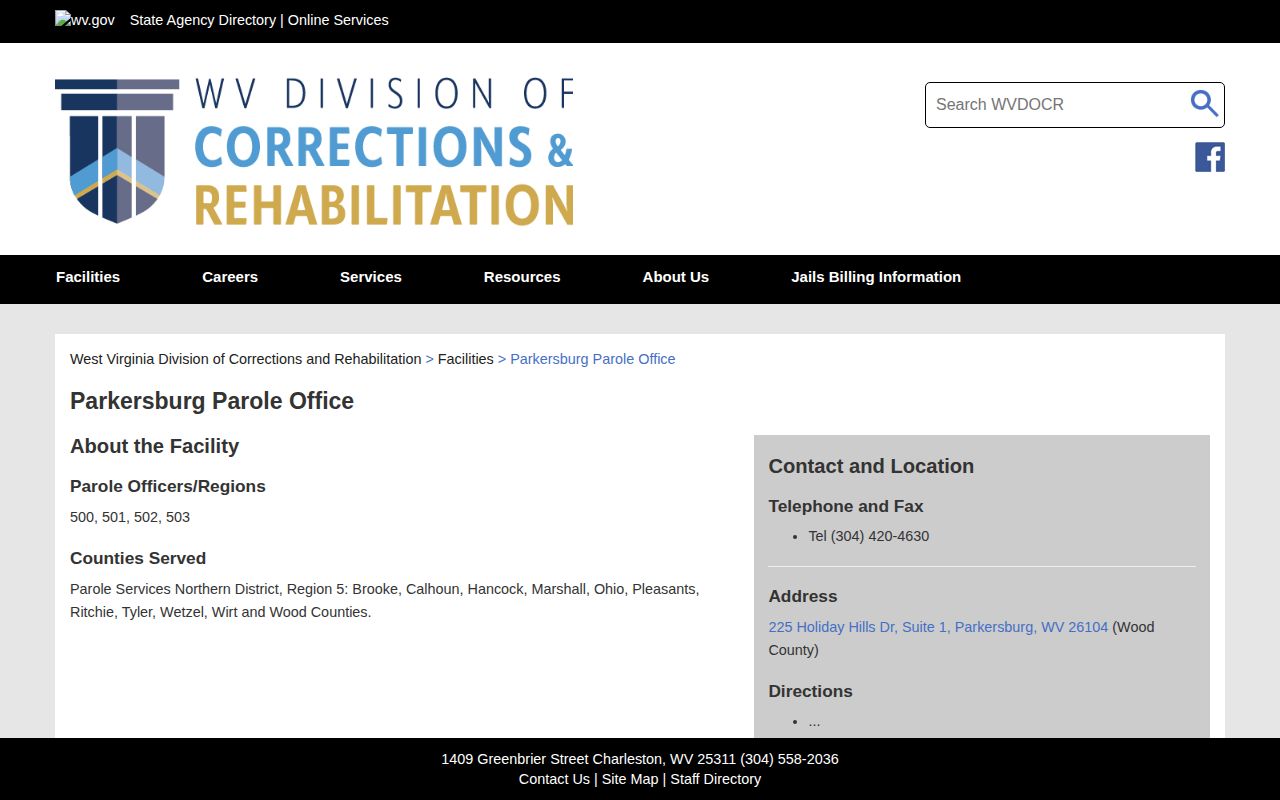
The office listing confirms the local WVDCR route, while the separate court directory remains the right route for Wood County probation.
Wood County Parole Hearing Milestones
The Parole Board calls the first consideration milestone a parole eligibility date, or PED. It is not a release date. Under West Virginia Code §62-12-13, eligibility depends on the sentence and other statutory rules. The broad rule addresses minimum terms for indeterminate sentences and one-fourth of a definite term, but offense dates, prior convictions, special offenses, and other limits can change the outcome. Section 62-12-13a makes clear that eligibility creates no right to release.
The Board describes monthly institutional hearings, including video hearings for Parkersburg Correctional Center and regional-jail inmates. This is a cadence, not a public dated calendar for each person. A denial leaves the person incarcerated. A set-up schedules later review. A grant means release to parole is planned after required conditions are met, yet the Board may rescind a grant before physical release in stated circumstances. WVDCR or VINE must still confirm the custody change.
The official parole-hearing page explains this cadence and PED distinction.
The captured source supports monthly scheduling, but it must not be read as a person-specific Wood County hearing or release calendar.
Wood County Absconder Status Checks
WVDCR's standard parole conditions require timely reporting, notice of arrests, and compliance with standard and special terms. A violation can lead to investigation, a warrant, or revocation proceedings. An alleged absconder is not someone who completed supervision. The label signals a claimed failure to remain in lawful contact and requires current confirmation.
Custody notices and formal statutory notices are also different. West Virginia VINE can provide a WVDCR custody-status alert, but it does not certify that parole was discharged or decide a violation. A written request for release or parole-hearing notice under West Virginia Code §62-12-23d must go to both WVDCR and the Parole Board because they are separate agencies. An ordinary VINELink registration does not replace those written requests. When a supervision issue leads to detention, save the alert wording and compare it with the jail result and revocation record.
WVDCR links an Escapees and Absconders search from its offender-search hub, but the live application was access-blocked during Wood County research. Its present fields and update schedule could not be verified. If a result appears, compare identity details and ask WVDCR or law enforcement to confirm it. Also check current regional-jail custody. A person released on parole may later return to a regional jail while a revocation matter proceeds.
The Parole Board handles final revocation decisions after a WVDCR report. Video hearings occur with the regional jail where the parolee is detained. This history can contain a valid past release and a later return to custody, so an old release record does not prove present freedom. VINE may help track the custody change, but it does not replace the revocation record.
Note: An absconder result concerns an alleged supervision problem, not proof that a Wood County sentence or parole term ended.
Wood County Release Property Records
WVDCR's offender-record inventory gives Wood County residents a precise path when a post-release question concerns papers, identification, or property instead of supervision status. Named OIS document types include the Inmate Personal Property Inventory, Discharge Document, and material used to secure a Social Security card or birth certificate for release. A narrow request for the named document is more useful than asking for an entire offender file.
State what needs correction or confirmation, identify the WVDCR document or field, and supply the person's full name, OID if known, facility, and custody dates. Protected parts may be withheld or redacted. The public request can still target the existing release or property field. If the issue instead arose at the Wood County Holding Center, route the request to the Sheriff's records contact because that short-term site and WVDCR do not keep the same record set.
This channel should not be confused with the probation office. Court probation staff supervise compliance with a court order; they are not the custodian for a WVDCR property inventory or prison discharge document.
Ending Wood County Release Supervision
Physical release and discharge from supervision are separate milestones. West Virginia Code §62-12-18 generally ties parole to the maximum sentence less lawful deductions. In qualifying cases, WVDCR may seek early discharge after at least one year on parole. Until discharge, a person living in Wood County can remain subject to reporting and other lawful conditions even though institutional custody ended long ago.
Probation can also end in more than one way. The court may record successful completion, modify the order, revoke probation, or enter another disposition. A docket label should be checked against the actual order when its meaning is unclear. If revocation results in new confinement, search the WVDCR jail system and the court case as current sources. The earlier probation start remains part of the history but no longer describes the whole status.
WVDCR policy describes an Official Certificate of Discharge and an OIS notation when supervision ends. That record is stronger than an assumption based on elapsed time. For probation, look for the court's completion, discharge, or revocation entry. Ask the proper office when the public docket does not explain present status. A transfer of supervision also differs from discharge: the local office may change while the legal term continues.
Keep three dates apart in any Wood County supervision check: departure from the jail or prison, start of parole or probation, and final discharge. That simple separation prevents a parole grant, a release alert, or an old probation order from being reported as the end of all legal supervision.